



- Size to your evening and overnight use. Smaller homes usually need 5–10 kWh, families 10–13 kWh, and high-usage or EV homes 15 kWh+.
- The federal rebate is about 30%. The certificate (STC) factor is 6.8 for installs until 31 December 2026. The full rate applies to the first 14 kWh only.
- The NSW VPP incentive stacks on top. The amount depends on your provider.
- Hybrid suits new solar, AC-coupled suits existing solar. Either way, the battery's inverter must be VPP-capable.
A solar battery stores the extra power your panels generate during the day, so you can use it at night instead of buying electricity back from the grid at a higher rate. It's the piece that gives solar its savings around-the-clock appeal.
Right now, there's also a real financial reason to get the sizing right. The federal Cheaper Home Batteries Program takes around 30% off eligible batteries, but that discount steps down every six months until the scheme ends in 2030. The full discount is only available for batteries with a capacity of up to 14 kWh; anything above results in a progressively lower rate. So the best solar battery storage is the one sized to your evening usage, not the biggest number on the quote.
Here's how to size, choose and install a home battery in Newcastle and the Hunter region, with the numbers.
How Does Solar Battery Storage in Newcastle Deliver Energy Independence?
A battery lets you run the house on your own stored solar after dark. There are three main benefits that matter:
1. Evening self-consumption
The midday surplus that would be exported for a few cents gets stored and used from 5pm onwards. As an example, shifting 8 kWh a day between a 5c export rate and a 35c evening rate saves $2.40 a day, or about $876 a year.
2. Blackout backup
Backup depends on the gateway and which circuits are wired to it. Tesla's Powerwall 3 delivers up to 11.04 kW continuous through a Backup Gateway 2. Enphase batteries need an IQ System Controller for backup. Tell us what must keep running, because backup kW matters as much as kWh.
3. Price exposure
The AER's final determination cut NSW residential flat-rate standing offers by 3.4% to 5.0% from 1 July 2026. Prices still move, and every kWh you store is one you don't buy at peak rates.
A battery isn't the same as going off-grid. A run of cloudy winter days will still see you topping up from the grid.
What Battery Capacity Do You Need?
Start with your bill and find your evening and overnight kWh. Match usable capacity to that, and check your solar can refill it each day. Here's our rule of thumb:
Rebates also favour right-sizing. The STC factor applies at 100% up to 14 kWh, 60% from 14 to 28 kWh and 15% from 28 to 50 kWh. We size batteries for homes across Lake Macquarie and rural blocks in the Hunter Valley.
Daytime-heavy sites should look at our solar battery installation for business service. NSW also runs a batteries for businesses incentive.
How Do the Leading Battery Brands Compare?
Warranty terms differ. Enphase counts cycles, Sigenergy counts energy throughput, and others count years, so compare the retained capacity at the end. We've installed Sungrow and Sigenergy systems and specify only from the Clean Energy Council approved list.
Virtual Power Plant (VPP) compatibility
Every on-grid battery in the rebate must be technically capable of joining a VPP. But VPP providers choose which battery models they accept. Confirm yours with the provider before you sign.
Hybrid or AC-coupled: Which Suits Your Solar?
- Hybrid (DC-coupled): One inverter handles panels and battery. It suits a new solar setup or an old inverter due for replacement.
- AC-coupled: The battery brings its own inverter and links to your existing solar system. It suits newer systems that work well.
For existing solar, the Clean Energy Regulator says your panels don't need to be on the CEC list. The inverter the battery connects to must be VPP-capable, though your existing solar inverter needn't be. The system also has to meet NSW electrical safety rules.
As local solar power installers in Newcastle, we check your inverter's age, make and metering on the first visit. Older inverters sometimes need replacing.
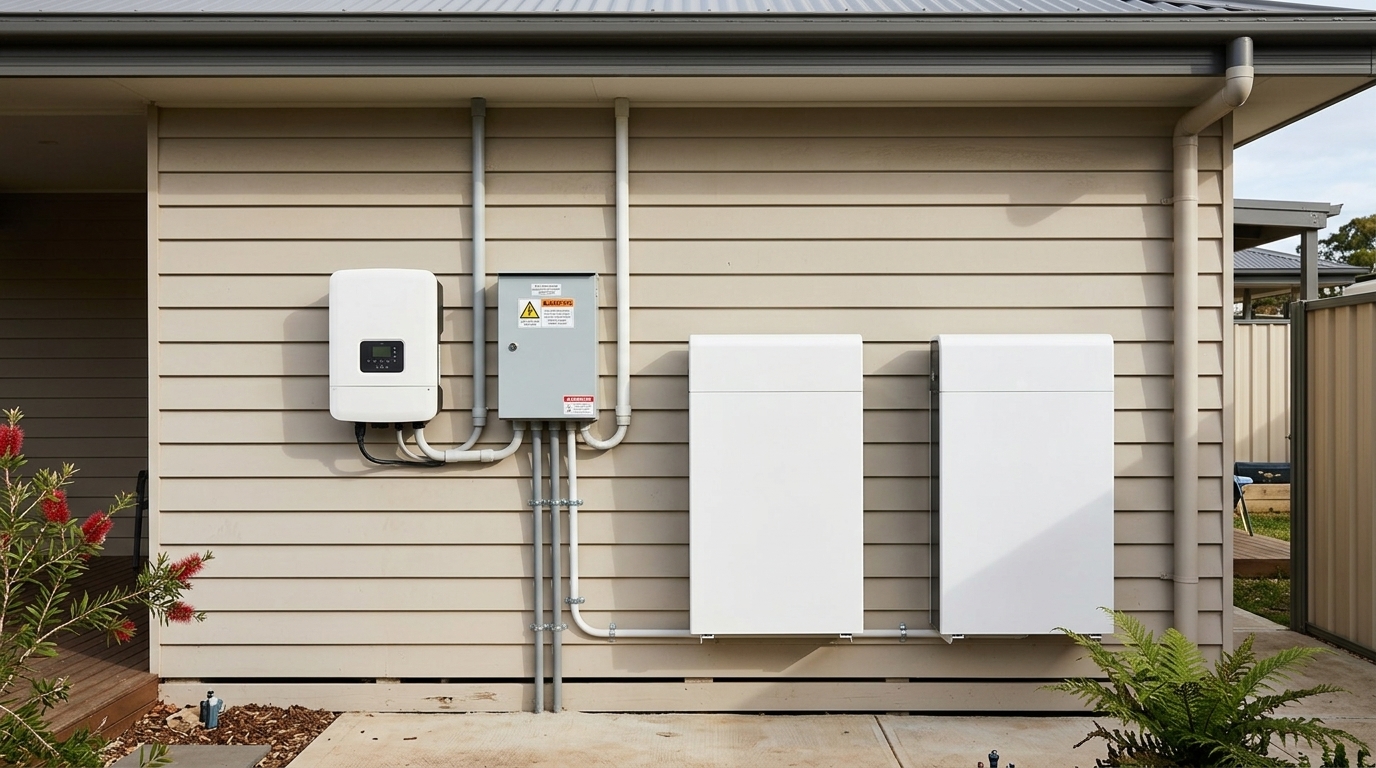
How Does Solar Battery Installation in Newcastle Work?
- Site assessment: We review 12 months of your bills and assess your switchboard, meter, existing inverter, and the spot where the battery will go.
- Sizing and quote: We size the battery to your evening and overnight use, then send an itemised quote with the rebate already applied.
- Approvals: Your installer lodges the connection application with your network operator, which is Ausgrid across most of Newcastle and Lake Macquarie. Ausgrid approves the application before any work begins.
- Installation: An accredited installer supervises on-site while a licensed electrician does the work.
- Testing and paperwork: Once the system has been tested, you receive a Certificate of Compliance for Electrical Work.
- Connection and monitoring: We commission the battery, sign you up to a VPP if you want one, and set up remote monitoring so you can track your savings from day one.
How Do the Federal and NSW Incentives Stack?
Federal
The discount is applied at the point of sale and is based on the STC factor on your install date. Certificates round down. The factor drops every six months, so the next step-down is due 1 January 2027. At roughly $37 per certificate (our calculation), the discount looks like this:
That third row adds only about $1,050 of rebate for 6.5 kWh more battery. Live STC prices move, so your quote is the number that counts.
NSW VPP Incentive
It's paid on up to 28 kWh for batteries from 2 to 50 kWh. The NSW Government sets no fixed dollar figure. Your provider's contract determines the amount, and it can be paid as an upfront payment, in instalments, or as a bill credit. We quote you the provider's actual offer.
Finance
The NSW Home Energy Saver program offers zero-interest loans up to $15,000 over up to 10 years for households with taxable income up to $210,000.
When isn't a Home Battery a Good Buy?
- Your evening and overnight use is low
- Your solar is too small to refill the battery after the house has taken its share
- You can move big loads, like the pool pump, hot water or EV charging, into daylight
- Retailers must now offer a Solar Sharer Offer with three free midday hours for smart-meter customers
- You only need outage cover for a couple of circuits. A smaller battery or generator may do
We'll say so if solar alone is the better buy.
Get Your Battery Sized Properly
Sine Wave Solar is a Warners Bay business. Our in-house, SAA-accredited team handles design, approvals, installation and grid connection. Book a free site assessment with our experts or call 1300 871 826, and we'll size a battery to your bills.
Founder, SAA-accredited installer
Sam has spent over 15 years working as an electrician across Newcastle and the Hunter. He founded Sine Wave Solar to design and install solar and battery systems in-house, from site assessment through to grid connection.


